
Key takeaways
- DIVA means Difficult Intravenous Access. A-DIVA scores five risk factors from 0 to 5.
- 0 to 1 is lower risk, 2 to 3 medium, 4 to 5 high risk of a failed first attempt.
- Two or three red flags? Escalate early. Multiple failed attempts are tissue trauma, not a badge of honor.
There is something electric about your first few successful IVs. The nerves. The poke. The flash. The thread. The flush. It feels like you just unlocked a superpower.
Then you do a few hundred. Then a few thousand.
The excitement settles. The ego quiets. What replaces it is something better: pattern recognition. After enough sticks you start to notice things. Certain patients, histories, and arms make you pause. Make you instinctively grab a smaller gauge just in case. That is where the A-DIVA comes in.
What DIVA means
DIVA stands for Difficult Intravenous Access. A DIVA assessment or scale helps you identify patients who are likely to require multiple attempts or advanced techniques for IV placement. Different facilities use slightly different tools, but most DIVA assessments look at things like:
- History of difficult IV placement
- Veins that are not visible or palpable
- Obesity or edema
- Chronic illness or frequent hospitalizations
- IV drug use
- Chemotherapy history
- Pediatric or elderly patients
It is not about labeling someone as hard. It is about anticipating difficulty before you poke.
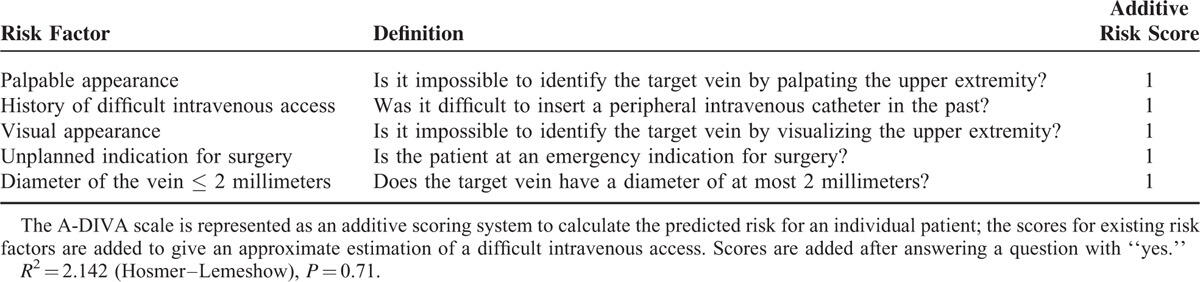
Scoring:
- 0 to 1: lower risk of a failed first insertion attempt
- 2 to 3: medium risk of a failed first insertion attempt
- 4 to 5: high risk of a failed first insertion attempt
In general, a higher score on the DIVA scale indicates a higher risk for difficult intravenous catheter placement. You can try it yourself with the interactive A-DIVA check on the homepage.
The early IV phase
When you are new, everything feels hard. You are still learning angles, depth, stabilization, and vein selection. Your hands are building muscle memory. Your eyes are learning what a healthy vein really looks like.
In that phase, it can be difficult to distinguish between a truly difficult IV and a skill set that is still developing. There is nothing wrong with that. In fact, there is value in it. Early in your IV journey, you need volume. You need repetition. You will miss. A lot. That is how your IV radar develops. You cannot shortcut experience.
Want the full technique, step by step? A Nurse's Guide to Intravenous Insertion covers it with photographed grips and real-world troubleshooting.
When experience changes the game
After enough sticks, patterns become obvious. You start recognizing:
- The dialysis patient whose veins feel like cords
- The oncology patient with fragile vessels
- The dehydrated elderly patient with teeny veins
- The anxious patient whose veins disappear the second you enter the room
Now you are not guessing. You are assessing. This is when a formal DIVA scale really becomes powerful. It validates what your intuition is telling you. It gives you language. It gives you structure. And most importantly, it protects the patient from unnecessary trauma.
Why nurses should use a DIVA assessment
Using a DIVA assessment benefits both you and the patient.
For the patient: fewer sticks, less pain, less anxiety, less delay in treatment.
For you: fewer failed attempts, less frustration, stronger clinical judgment, and better collaboration when escalating to ultrasound or vascular access teams.
It shifts the mindset from "try and see what happens" to "assess and act intentionally."
When you cannot use a formal DIVA tool
Not every setting has a formal scale. Some outpatient centers, ambulatory surgery units, or emergency situations may not have a structured DIVA protocol. In those cases, your alternative is structured clinical thinking. Ask yourself:
- Do I see or feel a good vein?
- Has this patient been stuck multiple times recently?
- Do they have a history of difficult access?
- Is time critical?
- Would ultrasound save this patient from multiple attempts?
If two or three red flags show up, escalate early. That might mean using a smaller catheter, asking a more experienced nurse, using ultrasound if available, or considering alternative access if appropriate. The goal is not to prove you can get it. The goal is to get it safely and efficiently.
The ego trap
One of the quiet dangers in IV insertion is pride. You get good. Really good. You start taking on the hard sticks. You enjoy the challenge. That is fine. Skill should be used.
But the DIVA framework reminds us that this is not a competition. It is patient care. Multiple failed attempts are not a badge of honor. They are tissue trauma. There is wisdom in knowing when to escalate.
The real takeaway
Early in your career, dive in. Do the reps. Build the skill. Later, refine it.
DIVA is not a crutch for inexperienced nurses. It is a refinement tool for experienced ones. It formalizes what your brain has already started to notice. It aligns your instincts with evidence-based practice.
The best IV nurses are not the ones who stick everyone no matter what. They are the ones who assess first, anticipate difficulty, and act strategically. Skill plus judgment. That is where mastery lives.
Reference
- van Loon, F. H., Puijn, L. A., Houterman, S., & Bouwman, A. R. (2016). Development of the A-DIVA scale. Medicine, 95(16). doi.org/10.1097/md.0000000000003428
This post is for education. Always follow your facility's policies and your scope of practice, and ask for help when you need it.