
Key takeaways
- Volume matters, but feedback matters more. Log every attempt and why it worked or didn't.
- Practice in phases: easy veins first, then harder sites, then difficult patients with backup.
- A miss is data. Debrief it in under a minute and you'll get better faster than nurses who just keep sticking.
Nobody walks out of nursing school good at IVs. You practiced on a foam arm with veins like garden hoses, maybe placed a few on real patients during clinicals, and now you're expected to get a line on a dehydrated 84-year-old during a busy admission. The gap feels huge. It's supposed to.
The good news: IV insertion is a motor skill, and motor skills follow predictable rules. Research on expert performance in medicine points to deliberate practice as the difference maker: focused repetitions, immediate feedback, and a specific thing you're trying to improve each time (Ericsson, 2004). Not just more sticks. Better sticks.
Here's a simple plan for your first 100.
Before you start: set up your IV log
Use a notes app or a small notebook. No patient identifiers. For each attempt, write down:
- Site (hand, forearm, AC) and gauge
- First attempt success: yes or no
- Did you see and feel the vein, or only one of the two?
- One sentence: what helped or what went wrong
Thirty seconds per entry. After a few weeks this log becomes the most useful IV textbook you own, because it's written about your hands.
Phase 1 (IVs 1 to 25): build the routine
Your only goal is a repeatable setup. Same order, every time: gather supplies, explain to the patient, position the arm, tourniquet on, assess both arms, clean, anchor, insert, advance, release, flush, secure. A consistent routine frees your brain to focus on the vein instead of remembering the next step.
- Choose the easiest vein you can find. Straight, palpable, bouncy, ideally in the forearm. Confidence comes from early wins.
- Palpate every time, even when you can see it. You're training your fingers to recognize what a good vein feels like.
- Ask your preceptor to watch, not take over. Agree ahead of time on a signal for when they should step in.
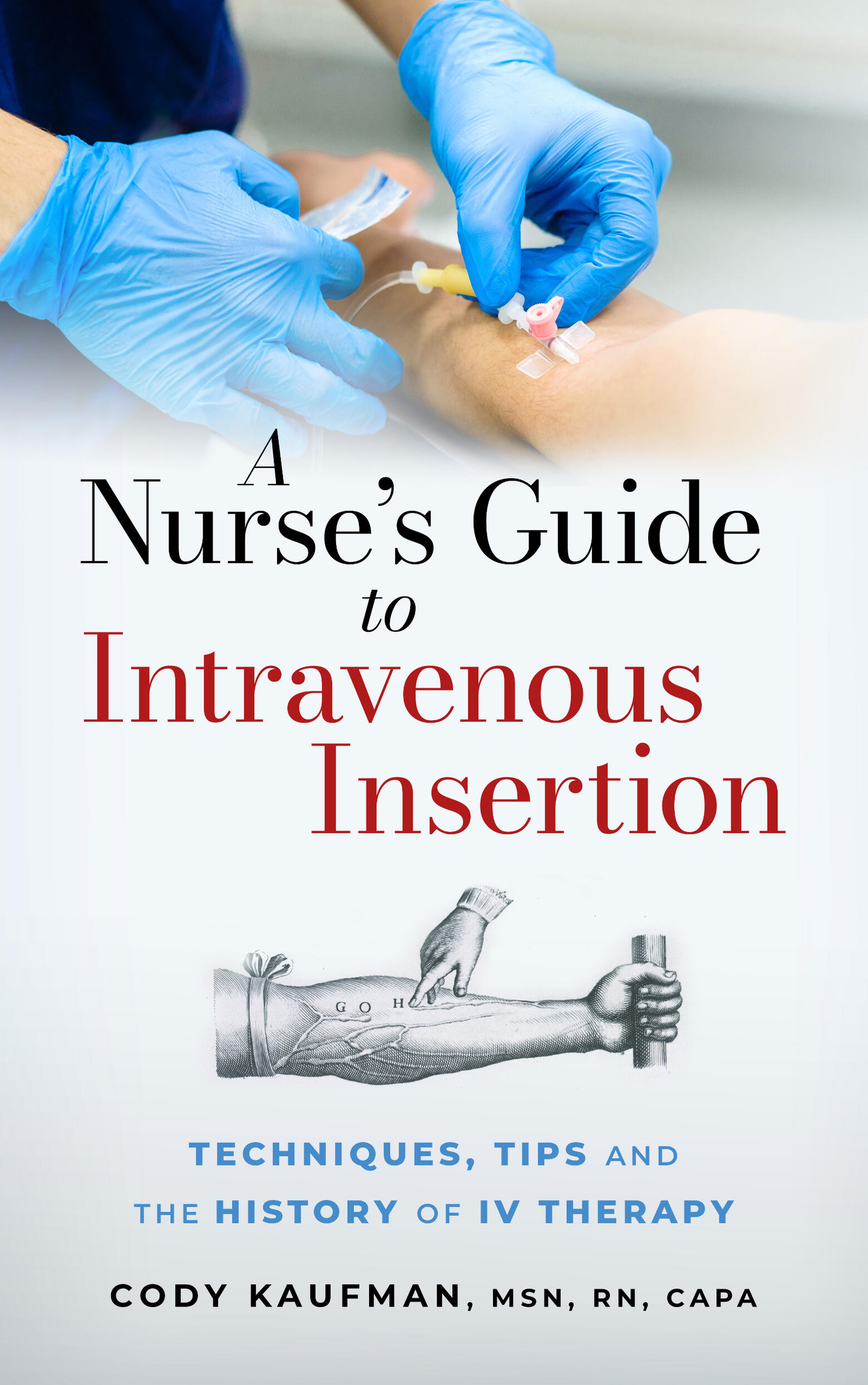
Want the full technique, step by step? A Nurse's Guide to Intravenous Insertion covers it with photographed grips and real-world troubleshooting.
Phase 2 (IVs 26 to 60): learn the anchor
Most early misses come from rolling veins and backwalling, and both are stabilization problems. Pick one grip and use it until it's automatic, then add a second. Pay attention to your angle: lower once you see flash, advance the catheter off the needle rather than pushing the whole unit forward.
This is also the phase to start hand veins and AC sites so you're not dependent on one location. Write down which grip you used in your log. Patterns will jump out quickly.
Phase 3 (IVs 61 to 100): harder patients, with a safety net
Now start volunteering for the tougher sticks, with backup available: older adults with fragile veins, patients with edema, frequent fliers who know exactly which arm "always works." Before each one, do a quick difficulty check with a tool like the A-DIVA scale (van Loon et al., 2016). If the score is high, plan your escalation before you start.
How to debrief a miss in under a minute
When you miss, ask three questions and write the answer down:
- Did I pick the right vein? Visible but not palpable veins fool everyone.
- Was it anchored? If the vein moved, the answer is no.
- What happened at flash? No flash, flash then lost, or flash then a blown vein each point to a different fix.
That's it. You'll notice your misses cluster around one of these. Fix that one thing and your success rate jumps.
The two-attempt rule
Many facilities limit each clinician to two attempts before escalating. Even if yours doesn't, it's a good personal rule. A third and fourth poke from the same tired hands rarely works, and every attempt costs the patient pain and future veins. Asking for help isn't failing the stick. It's protecting the patient.
What not to worry about
- Comparing yourself to the nurse with 20 years of sticks. They were where you are. They just have more entries in their mental log.
- Bad days. You'll have a day where you miss three in a row. Check the log. It's almost always one fixable thing, or just a hard patient.
- Speed. Smooth comes before fast. Fast follows smooth on its own.
Volume builds the skill. Reflection builds it faster.
Reference
- Ericsson, K. A. (2004). Deliberate practice and the acquisition and maintenance of expert performance in medicine and related domains. Academic Medicine, 79(10 Suppl), S70 to S81.
This post is for education. Always follow your facility's policies and your scope of practice, and ask for help when you need it.